University implementation

AI is already on your campus. CMPUS makes it something you can stand behind.

A structured AI platform for students, designed to work with universities. Sixteen purpose-built Classmates that plan, explain, question, grade, and run practice, inside boundaries your institution can review.
Provosts & deansTeaching & learning centresAcademic integrity officesFaculty & course instructorsStudent success teams
  1. Role-scoped ClassmatesEach one is scoped to a single academic job and is built to decline what falls outside it.
  2. Reviewable behaviourGuided intakes and consistent patterns. Evaluate it once, not every chat.
  3. Guided, not open-endedStudents bring the brief, the rubric, their attempt.
  4. No surveillanceNot a detection product. A structured environment your policy can reference.
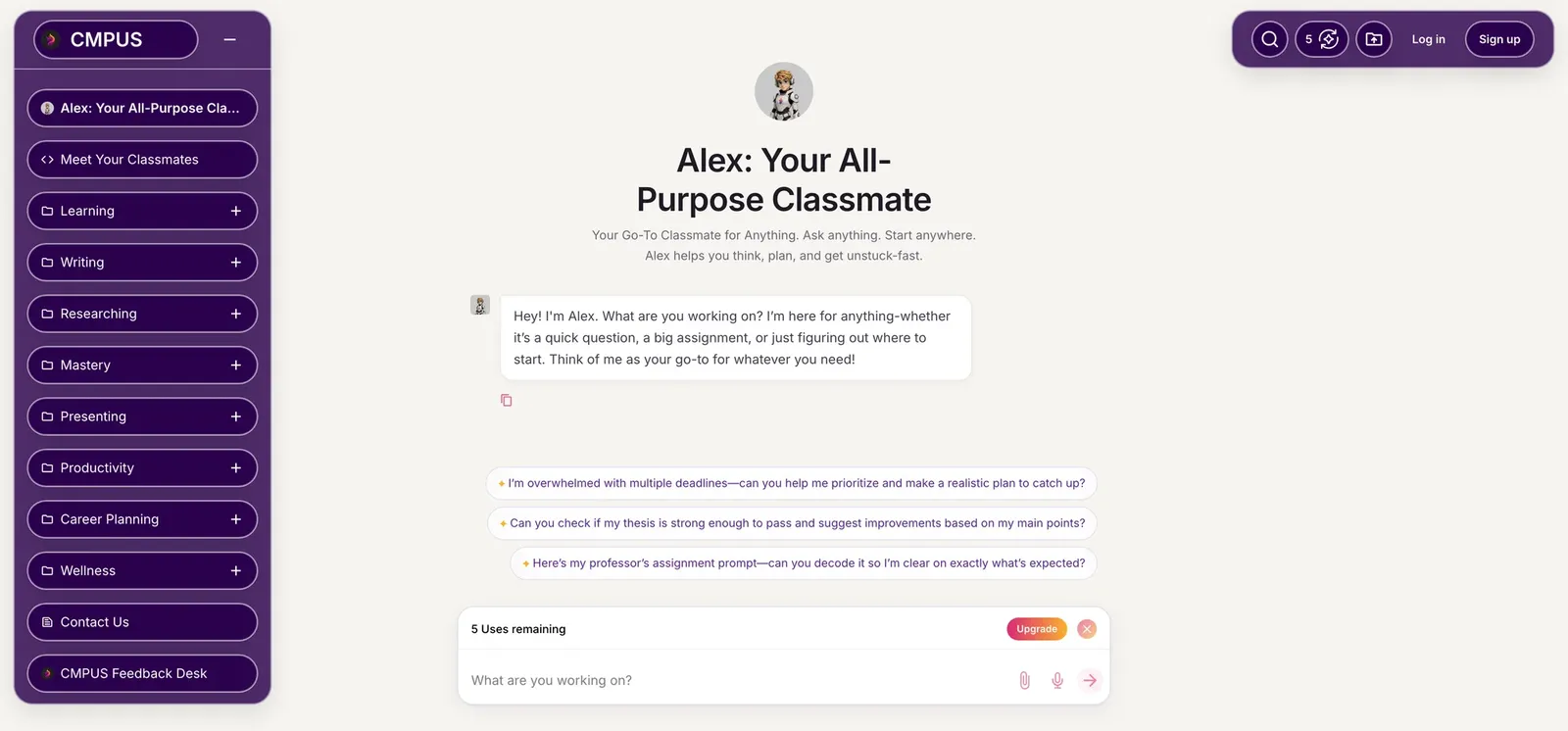
The CMPUS platform with governance callouts
1Role-scoped ClassmatesEach one is scoped to a single academic job, and is built to decline what falls outside it.2Reviewable behaviourGuided intakes and consistent patterns. Evaluate it once, not every chat.3Guided, not open-endedStudents bring the brief, the rubric, their attempt.4No surveillanceNot a detection product. A structured environment your policy can reference.
What it is
  • Sixteen role-scoped AI Classmates
  • Guided flows with guardrails
  • Ten models, one accountable layer
What it is not
  • A free-form chatbot
  • An assignment generator
  • A detection or surveillance tool
What we ask
  • One 30-minute conversation
  • A course or cohort to pilot
  • Your rubric and AI-use policy
What you get
  • A structured AI environment
  • Course editions under your rules
  • Faculty view without student transcripts
Executive summary

Three things a provost, a dean, and an integrity office each need to know.

The problemUnstructured AI is already the default

Students are already using ChatGPT, Claude, and Perplexity, with no academic scaffolding and no shared standard. Bans don’t remove it. Detection turns integrity into an arms race.

The approachConstrain the AI, not the student

Every Classmate has one academic role, a guided intake, and guardrails that produce plans, feedback, and practice rather than finished submissions. Behaviour is predictable and reviewable.

The evidence basePedagogy first, models second

Process before output, built with a University of Toronto PhD researcher. Ten AI models sit underneath, but the academic behaviour stays constant as models change.

In plain language

What actually happens when a student uses CMPUS.

They pick a Classmate, not a blank boxEach Classmate does one academic job: tutor, planner, grader, mock tester. There is no “write my essay” Classmate.
The Classmate asks before it answersWhat is the brief? What is the rubric? What have you already done? The student brings their own work in.
Guardrails applyThe output is structure, feedback, practice, and explanation. Not a finished submission with the student’s name on it.
The work stays theirsThe student leaves with something they could defend in an oral exam or an office hour, and a clearer sense of what they understand.
What faculty see

Patterns, not transcripts.

A course edition gives instructors a view of how the cohort is using CMPUS: which Classmates, for which assignments, and the questions students ask most. Never an individual student’s conversation.

Usage by Classmate and assignment. See where the cohort is leaning on support.
Most-asked questions. The concepts that did not land in the lecture, surfaced before the exam.
No surveillance. No transcripts, no per-student monitoring, no detection scores.
ECO101 · Faculty viewWeek 8 · 340 students

Exchanges by Classmate

  • Leo · Tutor
    412
  • Maya · Planner
    318
  • Jordan · Grader
    290
  • Quinn · Mock Tester
    204
  • Sofia · Sources
    150

Most-asked this week

  • 1Why does the sample mean’s variance shrink with n?
  • 2How do I structure the elasticity essay?
  • 3Is a working paper a credible source?
  • 4What does “critically evaluate” want from me?
Aggregated across the cohort. Individual conversations are never shown to faculty. Illustrative example, not a live deployment.
Custom deployments

A version of CMPUS for your course. Your material. Your guidelines.

Professors can get their own CMPUS for a single course: the syllabus, the readings, the rubric, and the AI-use policy you set. The Classmates work only inside those boundaries, so “can I use AI for this?” finally has a clear answer.

You provide
  • Syllabus and learning outcomes
  • Readings, slides, past rubrics
  • Your AI-use rules per assignment
We build
  • Course-scoped Classmates
  • Guardrails matching your policy
  • A simple faculty view
Students get
  • Help that knows the course
  • Clarity on what is allowed
  • Practice, feedback, structure
ECO101 · Principles of MicroeconomicsExample course edition · Fall term
Course edition
Classmates on
LeoMayaJordanQuinn
Materials
Lecture slides wk 1–8 · Textbook ch. 1–6 · Essay rubric v2 · Past midterm (practice only)
AI policy
Allowed
Explain concepts, plan essays, practice for the midterm
Grade drafts against the course rubric
Not allowed
Draft or rewrite submitted essays
Answer the graded problem sets
Faculty view
Which Classmates are used, for which assignments, and the questions students ask most. No transcripts of individual students.
Models and governance

Every top AI model, under one accountable layer.

CMPUS runs on the leading models and matches each Classmate to the one best suited to its task. What your institution reviews is not the model. It is the Classmate’s role, its guardrails, and its guided flow, which stay constant as the models underneath improve.

ChatGPTReasoning and writing
ClaudeLong-form and nuance
GeminiMultimodal and speed
PerplexityLive research
GrokCurrent events
MistralFast drafting
DeepSeekMath and logic
Kimi K2Long documents
GLMStructured tasks
MiMoLightweight tasks

Model names and logos are trademarks of their respective owners. CMPUS is an independent platform and is not affiliated with or endorsed by them.

Role-scoped by designA Classmate is scoped to its academic role. The Essay Grader grades; it does not draft. The Mock Tester tests; it does not answer the graded problem set.
Reviewable behaviourGuided intakes and consistent interaction patterns mean faculty can see what a Classmate asks for and what it returns, and evaluate it once rather than chasing every conversation.
Course editions under your rulesFor a custom course edition, your AI-use policy becomes the Classmates’ boundaries: which Classmates are on, for which assignments, with your materials and rubric.
Data handling on requestWe will walk your privacy and procurement teams through what is collected, where it is stored, and how it is used before any pilot begins.
Why this matters

AI on campus is not optional.

Banning it does not remove it. Ignoring it does not control it. Students are already integrating AI into their workflows, quietly, inconsistently, and without shared standards.

Unlike calculators or past technologies, AI evolves daily. The institutions that define structure now will shape how AI supports learning. The institutions that wait will be correcting habits their students have already formed. Most students are not trying to cheat. They are trying to work out what is allowed.

There is a second cost to the ban-and-detect reflex. AI is going into nearly every career your graduates are heading for, and employers are already hiring people who can use it well. A campus that only says no sends students out afraid of the tool they will use every day. CMPUS is built to be the sanctioned, pedagogically aligned way to learn AI while learning the subject: students keep the learning, and they leave AI-fluent.

The evidence base

Built on how people actually learn.

Classmate behaviour is designed with a University of Toronto PhD researcher, drawing on established theories of learning and motivation. Here is what it looks like inside a session, and the sources behind it.

The same question, four weeks apart
Can you explain supply and demand? I have a quiz Thursday.
Sure. Quick check first so I pitch this right: if coffee doubled in price tomorrow, would you buy more of it or less? Say it in your own words and we build from there.
Asks before it explains
What ChatGPT does instead
Supply and demand is a fundamental economic model that describes how the price and quantity of goods are determined in a market. The law of demand states that, all else being equal, as the price of a good rises, the quantity demanded falls. The law of supply states that as the price rises, producers are willing to supply more. The equilibrium price is found where the two curves intersect. Several factors can shift these curves, including consumer preferences, input costs, technology…
Six hundred words, none of them aimed at what you actually asked.
Leo’s support
90%Your own thinking
10%
After ChatGPTYou can reread the explanation.
After CMPUSYou can explain it, draw it, and apply it to a question you have never seen.
Tap a week. The support fades as your competence grows. That is the design, not an accident.
Test yourself before you readRetrieval practice
With ChatGPTYou paste the chapter, it summarizes. You read the summary once. By Friday it is gone.
With CMPUSQuinn quizzes you on the chapter first, then explains only what you missed. Pulling it out of your own head is what makes it stay.
Why it works. Students who tested themselves remembered far more a week later than students who reread (61% vs 40% in the original study). Roediger & Karpicke, 2006.
Help that shrinks as you growScaffolding that fades
With ChatGPTIt gives the same full answer in week one and in exam week. You never have to do the step yourself.
With CMPUSLeo gives full support at the start, hints later, and by the exam just checks your work. The skill ends up in your head, not in a chat log.
Why it works. This is the tutoring pattern the word “scaffolding” was invented for. Wood, Bruner & Ross, 1976.
Explain it backMetacognition
With ChatGPTIt never asks what you think. You can copy a paragraph you do not understand and nobody notices until the exam.
With CMPUSJordan asks why you believe your answer is right, then grades your reasoning against the rubric. You find out what you do not know before the exam does.
Why it works. Knowing what you know, and what you do not, is the skill behind every other skill. Flavell, 1979; Zimmerman, 2002.
Also built inCognitive load · big tasks arrive in pieces you can holdConstructivism · you build the idea, you do not download itSelf-determination · you choose the approach and the level of help
Findings go straight into how Classmates respond.
The six functions of a tutor · Wood, Bruner & Ross, 1976

The paper that defined “scaffolding” lists six things a good tutor does. Every guided flow on CMPUS is built around them.

1RecruitmentGets you engaged with the real task, not the busywork around it.
2Reducing degrees of freedomShrinks the problem until you can tell whether you have got it.
3Direction maintenanceKeeps you pointed at the goal when you drift to easier wins.
4Marking critical featuresPoints at the gap between your attempt and a correct one.
5Frustration controlMakes trying with a tutor safer than trying alone.
6DemonstrationModels the ideal move, then hands it straight back to you.
SourcesBruner, J. S. (1961). The act of discovery. Harvard Educational Review. · Deci, E. L., & Ryan, R. M. (1985). Intrinsic motivation and self-determination in human behavior. Plenum. · Dweck, C. S., & Leggett, E. L. (1988). A social-cognitive approach to motivation and personality. Psychological Review, 95(2). · Flavell, J. H. (1979). Metacognition and cognitive monitoring. American Psychologist, 34(10). · Karpicke, J. D. (2012). Retrieval-based learning. Current Directions in Psychological Science, 21(3). · Piaget, J. (1970). Science of education and the psychology of the child. Orion Press. · Roediger, H. L., & Karpicke, J. D. (2006). Test-enhanced learning. Psychological Science, 17(3). · Ryan, R. M., & Deci, E. L. (2020). Intrinsic and extrinsic motivation from a self-determination theory perspective. Contemporary Educational Psychology, 61. · Sweller, J. (1988). Cognitive load during problem solving. Cognitive Science, 12(2). · Sweller, J., & Cooper, G. A. (1985). The use of worked examples as a substitute for problem solving in learning algebra. Cognition and Instruction, 2(1). · Vygotsky, L. S. (1978). Mind in society. Harvard University Press. · Wood, D., Bruner, J. S., & Ross, G. (1976). The role of tutoring in problem solving. Journal of Child Psychology and Psychiatry, 17(2), 89–100. · Zimmerman, B. J. (2002). Becoming a self-regulated learner. Theory Into Practice, 41(2).
What you gain

From chaos to clarity.

For faculty
  • Classmates that reinforce your rubric instead of bypassing it
  • A clear, teachable answer to “can I use AI for this?”
  • Less time policing, more time teaching
For academic integrity
  • Predictable AI behaviour you can review
  • Guardrails designed in, not bolted on
  • Proactive conversations instead of reactive cases
For the institution
  • A structured AI environment at campus scale
  • One Classmate per academic job, deployable course by course or campus-wide
  • A platform built around your rubrics and your AI-use policy
How a partnership works

A typical pilot, scoped with your team.

Week 1ConversationThirty minutes with your teaching and learning or academic integrity lead. What is happening on campus today, and what would “good” look like?
Weeks 2 to 5PilotA course, a cohort, or a program. Success measures agreed up front. Faculty see what Classmates ask and return.
Week 6ReviewResults against the agreed measures, student and faculty feedback, and a go or no-go decision on wider rollout.
ThenRolloutCampus-wide access, faculty guidance, custom course editions, and refinement as research and your policies evolve.
Request a briefing

Thirty minutes with your team.

For provosts, deans, teaching and learning centres, academic integrity offices, and faculty who want to see it before they decide anything.

  • Live walkthrough of the platform, the Classmates, and the guardrails
  • How a custom course edition is built from your syllabus and policy
  • The pedagogical framework and the research collaboration behind it
  • Models, data handling, and what a pilot would measure

Or email hello@cmpus.ca. We respond within 24 hours, Monday to Friday.

Questions from academia

The ones deans and instructors ask first.

01Can CMPUS run for a single course?
Yes. Professors can get a custom version of CMPUS for their own course: their syllabus, their readings, their rubric, their AI-use policy. The Classmates work only inside the boundaries you set.
02Does CMPUS detect or police AI use?
No. CMPUS is not a surveillance or detection product. It is a structured environment where the AI itself is predictable, reviewable, and contained, so the conversation moves from catching misuse to designing good use.
03What pedagogy is it built on?
Every Classmate reinforces process before output: plan before writing, practice before exams, understand before summarizing, cite before submitting. We collaborate with a University of Toronto PhD researcher to keep the framework aligned with evidence-based learning principles.
04How does a pilot work?
A short conversation with your teaching and learning or academic integrity lead, then a scoped pilot (a cohort, a course, or a program) with success measures agreed up front, reviewed before any wider rollout.
05How is student data handled?
CMPUS is built on Pickaxe infrastructure. Before any pilot we walk your IT and privacy office through where conversations are stored, how long they are kept, and who can access them, and we put it in writing. Individual student conversations are never shown to faculty.
06What does a pilot measure?
Three things, agreed with you before week one: how many students use it and keep using it, how much of that use stays inside the course’s AI policy, and what students report about their confidence and their workload. We review the numbers with you at the midpoint and at the end.
07What about the wellness Classmates?
Nova and Kai are short, guided resets for a bad night or a bad month. They are not counselling, they say so, and they point students to your campus support services and to crisis lines when it is more than tonight. You can leave them out of a course edition entirely.
01Is CMPUS just ChatGPT with a different name?
No. ChatGPT is a blank box built for the entire internet. CMPUS is a campus of sixteen Classmates, each built for one academic job, with the prompting, the academic context, and the guardrails already in place. You never teach it how university works.
02Will using CMPUS get me in trouble?
CMPUS is built around academic integrity. Classmates plan, explain, question, grade, and run practice. None of them are designed to hand back a finished assignment with your name on it. You still have to follow your course’s AI policy, and CMPUS is designed to make that easy to do.
03Do I need to know how to prompt?
No. Every Classmate asks for what it needs first: the brief, the word count, what you already have. The prompting is already done for you.
04Do my Classmates remember me?
Yes. Ask Leo to explain a concept and Maya already knows it when she plans your essay. Your courses, assignments, and progress carry across the whole campus.
05Which AI models power CMPUS?
ChatGPT, Claude, Gemini, Perplexity and six more. Each Classmate runs on the model best suited to its job, so you never decide which AI is better or manage five logins.
06Can I try it before I pay?
Yes. Every visitor gets 5 free interactions a day with any Classmate, no sign-up and no card. Create an account with email, Google, or Microsoft when you want to keep your history.
01How do credits work?
One message to your Classmate plus one complete response back is one credit. It does not matter which model powers the Classmate or how long the answer is. No tokens, no multipliers, no surprise usage spikes.
02What do the plans cost?
Guest is free: 5 interactions a day, no sign-up. Junior is CA$10 a month for 300 credits. Valedictorian is CA$19 a month, unlimited. Refills are 40 credits for CA$5 or 80 for CA$10.
03Do credits roll over?
Credits reset each billing cycle to keep usage simple and predictable. If you upgrade mid-cycle, your allowance adjusts immediately.
04Can I cancel anytime?
Yes. No contracts, no commitments. Cancel from your account under Manage plan and you keep access until the end of the billing period. If anything goes wrong, email support@cmpus.ca and we will sort it out.

Pilots, course editions, and research collaboration. Start with thirty minutes.

Pilot programs, course editions, cohort rollouts, and research collaboration.

5 free interactions a dayNo sign-up, no card
Enter the CMPUS